Flock Cameras: Discussion on Sept. 29 Town Council Subcommittee agenda
Discussion on Councilor Gordon's proposed order to restrict use of Flock cameras, and anything else the public brings up, will take place on September 29 at Randolph Town Hall beginning at 6 PM for public comments. The proposed order has three parts:
Allow Flock data for local criminal investigations but close loopholes that allow leaks to ICE or other misuse.
Require monthly audits of Randolph's Flock data to identify leaks and misuse.
Institute a $300 per day fine for each misuse of Flock data.
To facilitate an open discussion, Councilor Gordon has prepared this "background research," with input from the Massachusetts ACLU plus numerous press sources:"
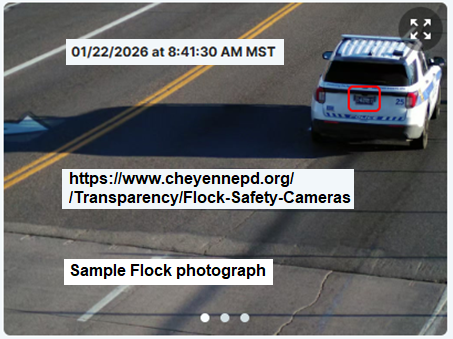
Flock cameras photograph the license plate and back bumper of every passing car (called "ALPRs," Automated License Plate Readers), and records the time and date that each car passed.
Randolph has 10 Flock cameras, situated at "ingress points" around town, such as main streets that border other towns.
Flock Safety, the corporation that makes Flock cameras, insists that Flock cameras cannot identify the driver or any individuals in the car.
And Flock Safety insists that ICE (and other federal agencies) are not legally allowed to get Flock data, by contract and by data security.
But Flock Safety cannot help with closing loopholes in data leaks to ICE -- they leave that to local police departments.
The Randolph Police Department has used Flock data to investigate local crime, and would prefer to keep Flock cameras for that purpose.
The goal of Councilor Gordon's proposed order is to allow RPD to use Flock data for criminal investigations, while closing the loopholes that cause misuse.
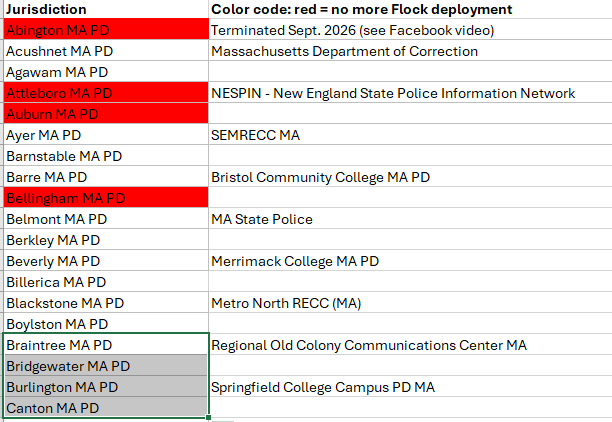
We will detail the loopholes next, but first, many people have asked for a list of which jurisdictions in Massachusetts use Flock cameras.
The Massachusetts ACLU maintains a list of police agencies that have contracted with Flock Safety -- they're in 109 towns as of mid-2026, of which two dozen have terminated Flock usage:
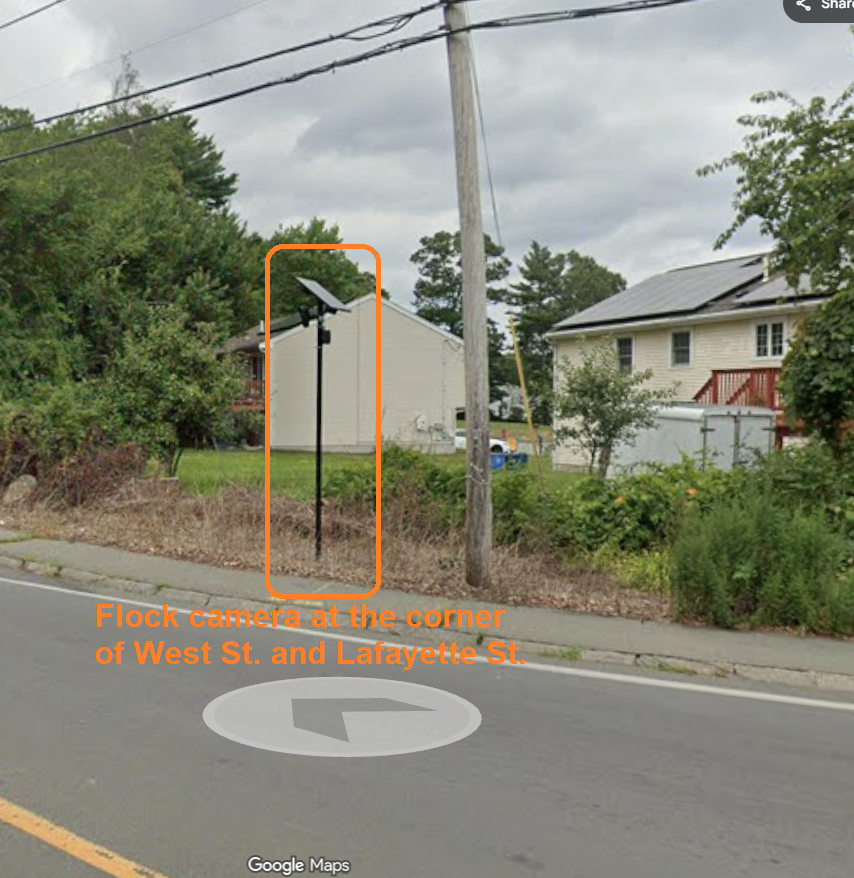
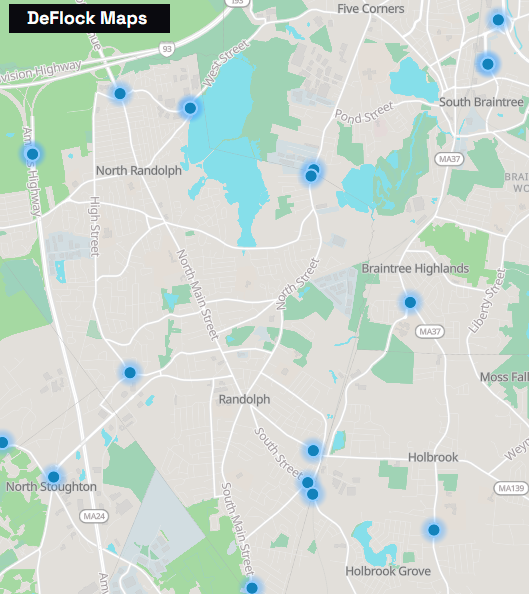
The organization DeFlock.org provides maps of Flock camera locations nationwide.
These include in Randolph: on Rt. 24; on Pond Street; on North Street; on North Main Street; on South Main Street; on Union Street; on South Street; on Centre Street; and on West and Lafayette (shown above).
Flock Safety agreed to speak to Randolph Town Councilors in two closed-door meetings in August and September 2026. These meetings were not open to the public, at the Town Council President's choice.
The police chief attended too, and Councilors could ask questions. Councilor Gordon asked for the Flock PowerPoint presentation to present to the public, but has gotten no response as of Sept. 7.
Their PowerPoint document outlined the reasons that a police department should adopt Flock cameras -- its components and reasons are related to those in this public video:
What are the loopholes that let Flock data get to ICE?
The public outcry against Flock cameras has two parts:
Invasion of privacy -- the proposed Council Order doesn't address these "Fourth Amendment issues"; a ban is discussed below.
Misuse of Flock data -- the proposed Council Order DOES address misuse, and establishes a process to identify and prevent future misuse.
The most important loophole is "social engineering," which means corrupt police officers "cheating" to misuse Flock data.
Only local law enforcement officers can request Flock data from Randolph -- not state police and not federal agents -- but other (outside of Randolph) local police officers could obtain Flock data and give it to federal agents, despite the rules against it.
When requesting Flock data, police officers must identify why they are requesting it -- but they can lie -- and they must identify a case for reference -- but they can lie about that too.
The percentage of corrupt cops is very low, but there are a LOT of Flock photographs -- over a billion a month! -- so the possibility is there.
Here are some cases where Flock data has been misused, starting with three Massachusetts cases, and then out-of-state references to immigration misuse:
Lynn police officers accused of stalking their ex-romantic partners:
"On Aug. 12, the department implemented Flock Safety's Audit Assist tool, which is designed to review use of the system.
The audit review revealed a concerning pattern in some searches. As a result, two officers were placed on paid administrative leave and an Internal Affairs investigation was initiated."
Source: 2 Lynn, Massachusetts, officers placed on leave after city's Flock system audit, WCVB-TV-5, Aug. 20, 2026.
New Bedford officer accused of Flock data misuse; New Bedford suspends Flock contract:
"A city police officer has been accused by an ex-girlfriend of using Flock license plate readers to follow her.
A day after The Light inquired about Pacheco’s alleged misuse of Flock with the Police Department, Police Chief Jason Thody announced the department was temporarily suspending its use of the Flock system pending a review of all past use."
Source: New Bedford police officer accused of using Flock cameras to track and follow ex-romantic partner, New Bedford Light, August 11, 2026.
Stow police officer resigns after Flock audit; Stow terminates Flock contract:
"The investigation found [the accused police officer] Rogers searched vehicle information through Flock Safety on multiple dates without a legitimate law enforcement reason.
The internal investigation sustained findings [including] improper use of an official position, and violations of department policies governing law enforcement databases.
The town placed Rogers on unpaid leave July 31. The Aug. 26 hearing was canceled after Rogers resigned.
The department ended its relationship with Flock Safety as a result of the investigation and removed its lone remaining camera."
Source: Stow police officer quits amid investigation into improper database, Flock searches, WCVB-TV-5, Aug. 26, 2026.
Texas police officer misuses Flock data to track a legal abortion out-of-state (because abortion is illegal in Texas):
"In Texas, a sheriff’s deputy used 83,000 Flock ALPRs to find a woman who had allegedly had a medication abortion, at the behest of her abusive partner.
Officers rarely enter specific reasons when they search ALPR databases. One officer repeatedly wrote 'la la la la,' and nobody noticed."
Source: The IJ Database of ALPR Abuse, Institute for Justice, Aug. 12, 2026.
ICE is exploiting a legal loophole to access license plate data, even in states where it's illegal; with 4,000 immigration searches last year:
"Although Flock’s policies bans using its cameras for immigration enforcement use, ICE found a loophole: instead of accessing the system directly, it asks local or state police, who do have access, to run license plates searches on its behalf."
Source:
LULAC (League of United Latin American Citizens) video on Facebook, Aug. 5. 2025.
Report of NY police passing data to ICE, and "obscuring" the reasons (which means "lying in case of an audit"):
"Our own police in New York state -- local and state police -- are making immigration-related searches, and beyond that, they appear to be hiding these searches.
At least two New York towns included 'ICE' in its searches of Flock's data, listing the reason for the search as either 'ICE' or 'Wanted by ICE.'
These were only the searches that were plainly listed for immigration purposes. The authors discovered a pattern:
After federal agents conducted searches that were tagged for immigration enforcement, a New York state or local police officer searched for the same plate, only listing their search reason as 'investigation.'"
Source: New York police agencies are searching Flock data to aid immigration enforcement, StateScoop.com, August 25, 2026.
Hundreds of 2025 searches state "ICE" or "immigration" in the search reason field.
Source: ACLU PPT source, slide 11;
Councilor Gordon refers to this situation as "naive corrupt cops," because querying for "ICE" or "immigration" is against the rules of Flock.
The StateScoop.com citation above details naive corrupt cops becoming lying corrupt cops.
"Flock actively shares data with out-of-state police departments (e.g., Florida Highway Patrol) that are deputized to support immigration detention and enforcement.
In the first half of 2025, the Florida Highway Patrol made over 12,000 searches of Flock's nationwide database, which includes many Massachusetts drivers' location information."
Source: ACLU PPT source, slides 11-12;
Councilor Gordon suggests a fix for this situation, by barring access from 287(g)-deputized police officers.
ACLU-Massachusetts suggests a framework for conducting audits below.
How do we close the loopholes?
We cannot stop corrupt cops from lying, but we can set up a system that catches them afterwards, and fines them as a civil penalty. That system is:
A monthly audit of Flock data : Look for cheating, like a user who always omits a case reference.
Flock automatically flags data if one license plate is checked dozens of times (this targets corrupt cops who are stalking their ex'es).
A naive corrupt cop might write "immigration" as the purpose of the search -- that is illegal, but would only get spotted during an audit.
Police officers who work in jurisdictions that allow 287(g) deputization should be subject to intense scrutiny, and/or blocked and fined when found to be misusing Randolph's data.
"287(g)" means ICE empowers local police officers to arrest people on behalf of ICE -- independent watchdogs maintain lists such as this 124-page list of agencies.
In general, officers who might be 287(g)-deputized should be barred from the Randolph Flock system, since corrupt cops there are most likely to help ICE.
The $300 per day fine means, if a corrupt cop forwards to ICE 100 photos, that's a $30,000 civil penalty. $300 per day is the maximum allowed by state law.
Many people have commented to Councilor Gordon on how the Flock audit should be handled -- the current proposal calls for a monthly audit without specifying the administrative details.
If left as-is, that means the administrative details are left to the Town Manager and the Randolph Police Department. The details might include some of the ideas above, or others.
The Council Order COULD be amended in Subcommittee to include administrative details -- in other words, if you are interested in this topic, you should come to the Subcommittee meeting and offer your opinion.
Some people have insisted that the Randolph Police MUST conduct the audit, since they are the only experts in reading Flock audit data and in sensing when a corrupt cop is lying.
Other people have insisted that the Randolph Police MUST NOT conduct the audit, since proper audits should be done by outside agencies.
Both those opinions are valid, and should be part of the Subcommittee discussion (and part of the open public discussion, in general).
The ACLU of Massachusetts suggests this framework for conducting audits:
"The audits shall include, but not be limited to, a detailed review of the following:
every outside agency with which information was shared; the number and purpose of searches;
searches involving federal or state agencies; the number of arrests made as a result of Collected Data;
the number of authorized users; and proof of timely deletion of Collected Data.
Each audit shall involve a detailed examination of at least 20 ALPR searches or 10% of the total number of ALPR searches in a given month (whichever is greater),
conducted at random, involving: a review of the underlying police report related to the search. The ALPR audit shall be shared with the Council and posted on the City’s website.
"In addition, requiring that every search have a corresponding case number/investigation identifier is one step that police departments can take to make audits more effective.
Source: Email correspondence with ACLUM's Gideon Epstein, Aug. 27, 2026
Why can't we just ban Flock cameras in Randolph?
Many jurisdictions in Massachusetts have banned Flock cameras. To do so in Randolph, the Town Council would have to hear from the public enough to persuade a majority (5 out of 9) to vote for a ban.
That has not happened in Randolph, but if you want to speak out, your chance is at the upcoming hearings on Councilor Gordon's proposed order.
Alternatively, the police chief would have to hear from the public enough to overcome the benefits for local criminal investigations.
Councilor Gordon's interview in July with the Police Chief (plus three deputies) was the first detailed complaint RPD had heard -- it's up to the public to say more.
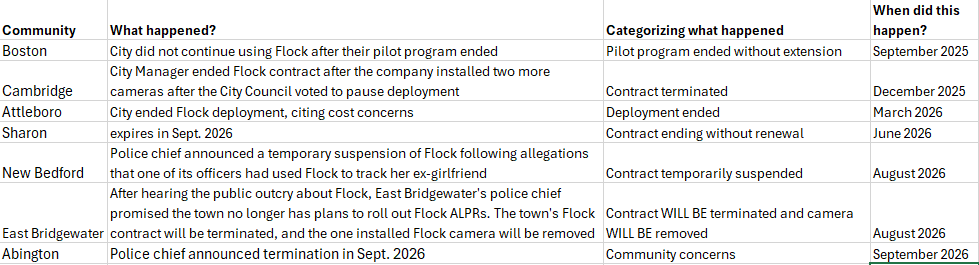
Here are some cities and towns that have banned Flock cameras (from the Massachusetts ACLU as of August 2026):
Some additional recent terminations have affected nearby towns. We include a couple of nation-wide commentaries, since the Flock camera controversy has become a national issue, not just in Massachusetts:
Stoughton held a meeting Tuesday night [9/8/26] on the Flock cameras in town and decided to cancel their contract.
The acting police chief said all equipment must be moved by Oct. 1.
Bags will be placed on the controversial cameras starting on Wednesday.
Source: Full text ; Original on WCVB
Quincy 's City Council held a meeting Tuesday night to discuss the city;s use of controversial Flock cameras, as public concern grows across Massachusetts over automated license plate reader technology.
Several residents opposed the cameras, but Quincy's police chief defended them, saying they are an important investigative tool and that restrictions govern how they are used.
Source: Full text from WCVB ; Statement by Quincy Police Chief in defense of Flock
East Bridgewater suspended its Flock contract: Chief of Police Michael Jenkins wrote, "When we originally evaluated the program, we believed ALPR technology could provide an additional investigative tool.
After considering recent developments surrounding ALPR technology, concerns regarding data practices and security, and the questions and concerns raised by members of our community, I have determined that continuing with this program is not the right decision for East Bridgewater at this time."
Source: Full text ; Original on Facebook
Video summary: The Abington Police Chief responded, in September 2026, to a public outcry, and unilaterally stopped using Flock cameras accordingly.
Source: Click for Facebook video ;
Alternative Facebook posting.
A dozen Flock cancellations in Milwaukee [Wisconsin] area: Excerpt from article:
Lt. Michael Luell, the sheriff's public information officer [said], "the [Flock Safety] company believed if it stripped the data of any identifiable nature, it was then considered to be the company's property and no longer the city's.
"Our contract, from my reading of it is, it stated they agreed not to distribute or sell our data," Luell told the Journal Sentinel. "But they had this legal theory."
Source: Full text ; Original on MSN.com
Excerpts from CNet article: "Since Flock Safety began partnering with law enforcement, a growing number of officers have been found abusing the surveillance system.
In one instance, a Kansas police chief used Flock cameras 164 times while tracking an ex.
In another case, a sheriff in Texas lied about using Flock to 'track a missing person,' but was later found to be investigating a possible abortion.
In Georgia, a police chief was arrested for using Flock to stalk and harass citizens.
Excerpt from NBC Boston: "Another Massachusetts police department is putting its Flock Safety license plate reader cameras on pause, this time for violations by its own police officers misusing the technology -- the New Bedford Police Department is looking into whether one of its officers used the technology to track her ex's girlfriend's vehicle.
Protests prompted the New Bedford City Council, which was hearing the allegations of misuse by one of their police officers this week, to shut down its meeting."
Source: Full text ; Original on NBCBoston.com
Compromise that restricts misuse but allows Flock use
Councilor Gordon's proposed order to restrict use of Flock cameras is a compromise.
It does not propose to ban the use of Flock cameras, but instead to address the misuse of Flock cameras.
Compromise solutions are more "subtle" (i.e. harder to understand) than extreme legislation -- everyone can understand a ban, and everyone can understand allowing the police to use Flock any way they see fit.
Those are the two extremes, and this Council Order attempts to compromise in the middle, allowing the Randolph Police Department to continue using Flock cameras for local criminal investigations, while closing the loopholes on misuse.
If you want to advocate for either extreme (or support the proposed compromise!) please come and say so -- there are two upcoming opportunities: On Monday Sept. 14 sometime after 6 PM at Randolph Town Hall, you can make public comments on this topic.
Councilor Gordon will introduce this Council Order later in the meeting, and a Subcommittee hearing will be scheduled. You can speak at the Subcommittee meeting for a longer time (limit is 3 minutes in the general meeting), and you can ask questions and get answers.
Councilor Gordon's order has four major purposes:
Respect the preference of the RPD to keep Flock: RPD has used Flock cameras to solve local crimes, and prefers to continue their usage, while adding guardrails against Flock misuse.
Protect residents of Randolph from misuse of Flock data: Flock cameras have loopholes that can leak data to ICE and other inappropriate uses, and closing those loopholes is the responsibility of RPD, not the responsibility of Flock.
Give the people of Randolph a venue to express their opinions on Flock cameras: As the whistleblower on this issue, Councilor Gordon has heard a lot from residents individually; many people have many opinions and it's time the Town Council provides a public venue for those opinions to be heard.
Maintain a positive trust relationship between the RPD and the community: Many local organizations have spent years building a good relationship with the Randolph Police, and RPD has reciprocated accordingly. The goal is to build on those good relationships by working together to solve a real problem.
Councilor Gordon is open to editing his Council Order based on what people, and other Councilors, say at the Subcommittee hearing.
The Council Order will likely be assigned to the Public Safety Subcommittee, on which Councilor Gordon is not a voting member.
But the Town Council's tradition is to allow other Councilors to ask and answer questions during the Subcommittee hearing, even though they have no formal vote.
In other words, interested members of the public need to persuade the 2 out of 3 members of the Subcommittee to their point of view, to edit the Order (and then 5 out of 9 when the Council Order is returned to the full Town Council).

.png)